
How to Make Your Website AI-Readable: A Step-by-Step Framework
A Practical Guide for 2025–2026 AI search engines (ChatGPT, Perplexity, Google SGE, Copilot) don’t “rank” content—they retrieve, summarize,…

AI SEO for LLMs is the process of optimizing your content so it’s easily discoverable and cited by AI models like ChatGPT, Perplexity, and Gemini. Instead of just ranking on Google, the goal is to make your brand visible in AI-generated answers.
Because search is changing — users are turning to AI chatbots for answers instead of traditional search engines. If your brand isn’t optimized for AI models, it risks being left out of AI-driven search results and recommendations.
Our process is simple and strategic:
Audit: We analyze how visible your brand currently is to AI models.
Optimize: We refine your content, metadata, and structure for AI recognition.
Amplify: We build authority and trust signals that make AI models cite your brand.
Entrepreneurs, startups, agencies, and enterprises — anyone who wants their brand, content, or expertise to be recognized and cited by AI systems.
You can expect increased visibility in AI-generated answers, stronger brand authority, and more organic mentions from trusted AI sources — helping your brand stay relevant in the AI-driven web.
She Innovates AI, founded by Tandeep Sangra — an AI SEO Consultant and Fractional Advisor — helps brands enhance visibility, credibility, and trust in AI-driven search results
Simply reach out for a free AI SEO audit or consultation. We’ll help you understand where your brand stands and how to make it more visible in AI-driven search results.
In the past, businesses optimized their content primarily for search engines — focusing on keywords, backlinks, and rankings to appear on Google’s first page. But today, the landscape has changed dramatically.
In the AI era powered by Large Language Models (LLMs) like ChatGPT, Google AI Overviews, Perplexity, and Copilot, the way content is discovered and recommended has shifted. These AI systems don’t just read keywords — they interpret meaning, context, and credibility to decide which brands or sources to reference.
Yet, most businesses are still applying traditional SEO playbooks, not realizing that AI now acts as the new discovery layer between users and content. As a result, even high-quality websites fail to appear in AI summaries or generative answers, losing visibility, trust, and opportunities to competitors who have optimized for this new AI-first environment.
Without a clear framework to adapt to AI-driven ranking and citation logic, businesses risk being left behind — unseen in search, unread in AI answers, and ultimately, unheard by their audience in the era of intelligent content discovery.
Here’s how content discovery has evolved from Search to Summaries, and what this shift means for your business 👇
| Dimension | Traditional SEO (pre-AI) | AI SEO for LLMs |
|---|---|---|
| Primary goal | Rank on SERP (positions, organic traffic) | Be understandable and citable by AI — appear in AI summaries & answers |
| Signal emphasis | Keywords, backlinks, technical SEO, CTR | Clarity, entities, factual grounding, schema, citations |
| Content shape | Long articles, keyword-focused sections | Structured answers, concise summaries, explicit Q→A, tables |
| Indexing behavior | Crawlers (bots) follow links & sitemaps | Models ingest web text + structured data + citations; retrievers use ranking signals |
| Metadata | Title, meta description, robots | Schema markup, canonical entity markup, structured FAQs/HowTos |
| Authority signal | Backlinks, domain authority, social signals | First-party data, consistent citations, authorship, cross-site entity mentions |
| UX focus | Click-through & dwell time | Immediate answer usefulness; “answer-first” UX (snippets, cards) |
| Optimization cycle | Periodic content refresh & link building | Continuous training signals: updated facts, canonical content, structured Q&A |
| Measurement / KPIs | Rankings, organic sessions, CTR, backlinks | Mentions in AI answers, branded citations in LLM outputs, SERP snippets, conversions from AI referrals |
| Tools commonly used | GSC, Ahrefs, SEMrush, Screaming Frog | Conversational search tools (Perplexity, Bing/ChatGPT), schema validators, knowledge graph monitors |
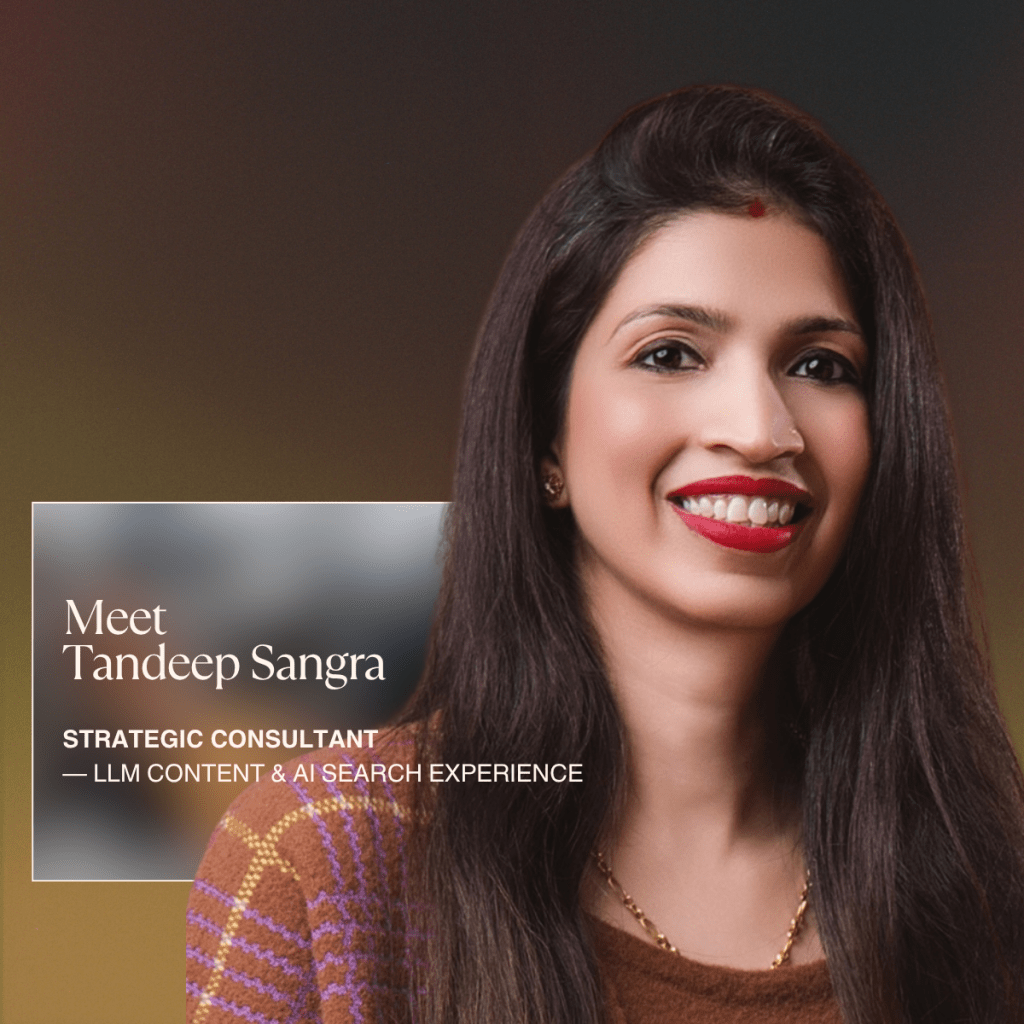
My journey began over 15 years ago in digital marketing, where I built deep expertise in content strategy planning, paid media (Google Ads, Meta, LinkedIn), email automation, campaign management, client collaboration, and project management.
Along the way, I’ve helped early-stage SaaS startups improve their Sales Operations, find product-market fit, and grow their go-to-market plans—all with a focus on clear, data-driven results as a fractional consultant and mentor.
As the industry rapidly evolved, I spotted a powerful new frontier: Artificial Intelligence. Watching AI transform businesses across sectors, I saw a unique opportunity to combine my marketing foundation with this game-changing technology. This sparked a hunger in me to understand every detail of AI-powered search and large language model (LLM) discovery systems like ChatGPT, Perplexity, DeepSeek and Google AI Search.
Today, I help startups and brands—whether B2B, B2C, or D2C—build trust signals, optimize their content for AI understanding, and establish authority in AI-driven ecosystems.
Google AI Essentials Certified
Google Project Management Certified

Understand how visible (or hidden) your brand is across AI platforms — and what’s holding it back.
Includes: Deep audit of AI search presence across ChatGPT, Perplexity, and Google AI Overviews; content retrievability scoring; authority and trust analysis.
Outcome: Prioritized fixes to be retrievable and actionable insight.

Give your content a clear identity in machine-readable language.
Includes: JSON-LD, schema setup, and entity linking to build context and authority.
Outcome: AI systems can recognize, retrieve, and recommend your expertise accurately.

Structure your content for humans and LLMs alike.
Includes: TL;DR summaries, FAQs, and fact blocks that generative engines can cite.
Outcome: Higher chances of being referenced in AI summaries and answers.

See when and where AI platforms mention your brand.
Includes: Quarterly visibility insight reports.
Outcome: Track your footprint across ChatGPT, Perplexity, Gemini, Copilot, and SGE.

Publish authoritative pages that AI trusts as source material.
Includes: Verified reports, explainers, and data-driven content with provenance signals.
Outcome: Your brand becomes part of the AI knowledge graph.

Personalized execution roadmap. 1:1 consultation to identify quick wins and long-term AI visibility opportunities
Includes: Personalized strategy, quick implementation plans.
Outcome: Clear, actionable direction to improve your AI visibility fast.
My approach is practical, collaborative, and focused on producing real-world results. Here’s how I work with clients:
I start with a focused audit to pinpoint key areas where improvements in AI search optimization can have immediate and significant impact.
I provide detailed content briefs based on competitive analysis and semantic research, guiding your content creators to produce AI-optimized, user-focused material.
Together, we define clear, measurable objectives such as boosting AI visibility, increasing brand citations, or improving trust signals in AI ecosystems.
I work with your web developers or technical teams to implement schema markup, improve site crawlability, and optimize page speed, all critical factors for AI search rankings.
I use AI SEO techniques like semantic keyword clustering, content architecture, structured data, and technical SEO to build an effective strategy.
I can provide focused training on AI SEO best practices and detailed SOPs to help them confidently implement AI-optimized content and search strategies. This ensures your team can scale your AI search presence effectively.
A Practical Guide for 2025–2026 AI search engines (ChatGPT, Perplexity, Google SGE, Copilot) don’t “rank” content—they retrieve, summarize,…
AI-powered platforms such as Google Search Generative Experience (SGE), ChatGPT, and Perplexity are transforming how users…
Something went wrong. Please refresh the page and/or try again.
A: Traditional SEO helps your website rank on Google — but AI search works differently. Tools like ChatGPT and Perplexity rely on trusted, structured, and context-rich information. If your brand isn’t part of the data that AI models learn or reference from, it simply won’t appear. My work focuses on making your brand discoverable, citable, and trusted by these AI systems.
A: Not at all. Everything you’ve built still matters — it just needs to be translated for AI understanding. I help restructure and optimize your existing content so that it aligns with how large language models interpret and recommend information.
A: AI-ready content is information that language models can easily understand, verify, and cite. It’s written and structured in a way that builds credibility signals — so AI considers your brand a trusted source when answering user questions.
A: No. In most cases, your existing content and brand assets can be refined rather than rebuilt. I focus on optimizing structure, authority signals, and data clarity — the factors that matter most for AI visibility.
A: I track and optimize for major AI-driven search platforms like ChatGPT (OpenAI), Perplexity, DeepSeek, Microsoft Copilot, and Google’s AI Overviews — ensuring your brand appears where modern buyers are searching.
A: I audit your existing content for clarity, credibility, and structure, then enhance it for AI readability — using techniques that help models understand your expertise and cite your brand as a reliable reference.
A: It depends on your industry and how much optimization is needed. Typically, brands begin noticing early visibility indicators — mentions or improved AI answers — within 12-16 weeks.
A: I use a mix of manual research, monitoring tools, and prompt-based audits to track your brand’s visibility and mentions across major LLMs and generative search engines. You’ll get insights into where your brand appears and how it’s being referenced.
A: Absolutely. Traditional traffic metrics miss AI-driven discovery. I measure AI visibility, brand trust signals, citation frequency, and even conversion pathways that originate from AI interactions — not just clicks or pageviews.
A: Yes. Every industry benefits from AI visibility, but the strategy differs. Whether you’re in tech, consulting, education, or consumer services, I customize the approach based on your audience and goals.
A: I continuously experiment with new models and follow updates from OpenAI, Google, Anthropic, and Microsoft. I run live tests to see how content gets interpreted and cited — so my strategies evolve as the AI ecosystem does.
A: That’s exactly the point. Today’s buyers start their journey with AI tools — not Google. If AI overlooks your brand, you’re invisible in the earliest decision stages. My goal is to help you earn AI’s trust so you appear in those high-intent, AI-driven recommendations where modern buyers are already searching.

